

A disciplined approach to self-storage investing starts with the right operator.
At Scaffold Partners, we believe successful real estate investing begins with two fundamental questions: Are we partnering with the right operator, and does the investment make sense on its own merits?
We focus on self-storage investments alongside experienced operating partners. Our role is to evaluate the people, the opportunity, and the underlying economics before committing capital—and to maintain an active investment oversight process after closing.
We combine operator-level diligence, independent underwriting, downside analysis, and ongoing monitoring to help our investors make informed decisions about what to invest in.
Our process is designed to be selective, transparent, and aligned with the long-term interests of our investors.
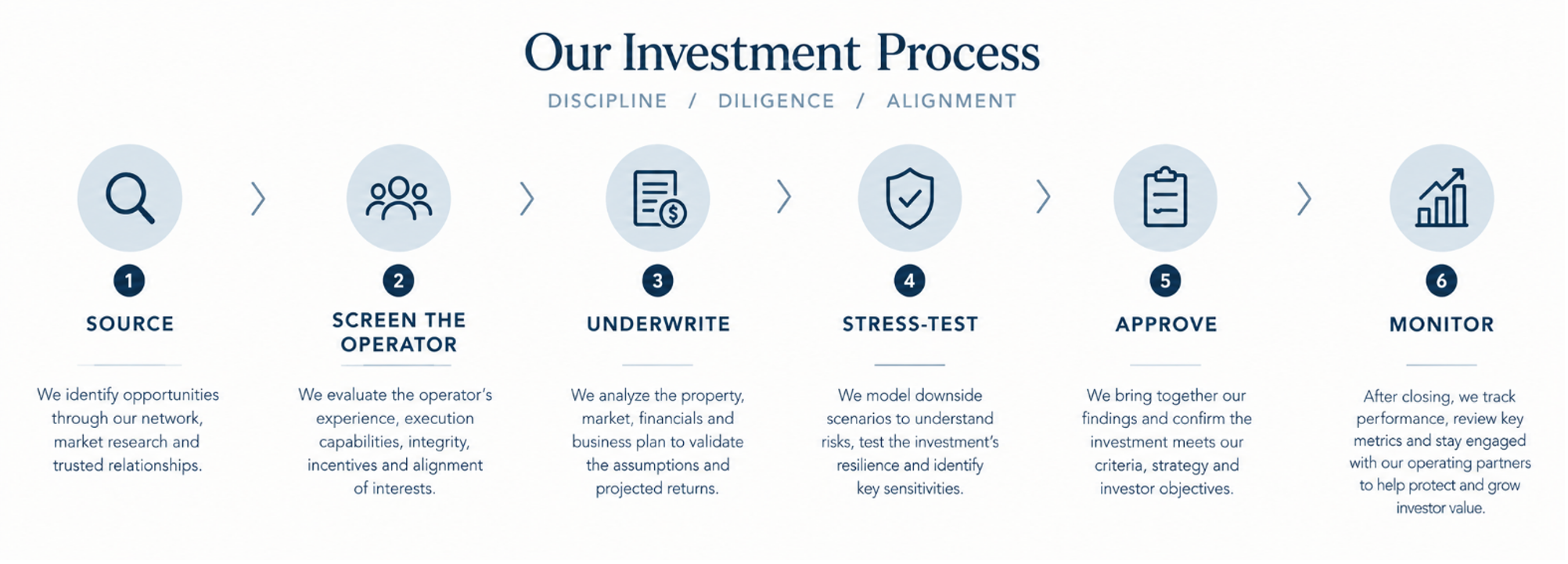
1. Sourcing and Screening Opportunities
We start with relationships, not just real estate.
Not every attractive-looking property represents an attractive investment. We begin by evaluating the operating partner, the investment strategy, and the opportunity itself before advancing to a deeper review. We typically review at least 50 opportunities a year but only invest in 2 or 3 of them.
Our initial screening considers:
- Strategic fit: Does the opportunity align with our investment focus and criteria?
- Market fundamentals: What are the local supply and demand dynamics, competitive landscape, population and employment trends, and barriers to new development?
- Business plan: Is the strategy clearly defined and supported by evidence? We typically acquire value-add properties with clear improvements we can make.
- Capital requirements: Are the proposed equity, debt, reserves, and projected future funding needs appropriate for the plan?
- Initial risk assessment: What are the principal risks, and are they identifiable and potentially manageable?
Just because the projected returns look attractive does not mean we will consider the investment.
2. Evaluating the Operating Partner
The operator matters as much as the asset.
Self-storage is an operating business as well as a real estate investment. Property-level results depend on the quality of the operator, its execution, its systems, and its ability to respond when market conditions change. We work with only a handful of carefully selected operators.
We evaluate the people responsible for executing the business plan, including:
- Relevant experience: Track record with comparable assets, markets, and investment strategies.
- Execution capability: Ability to manage leasing, pricing, marketing, customer service, staffing, maintenance, and capital improvements.
- Financial discipline: Budgeting, expense management, reporting, liquidity, and ability to manage through periods of underperformance.
- Integrity and transparency: Willingness to provide clear information, address difficult questions, disclose conflicts, and communicate setbacks.
- Alignment of interests: The operator's capital contribution and economic exposure relative to those of our investors.
- References and background: Appropriate review of professional history, prior investment performance, relevant references, and available background information.
We look beyond projected returns to understand how an operator has performed in different market conditions, what drove prior results, and how it handled challenges.
Our objective is to identify partners whose experience, judgment, and incentives support the successful execution of a business plan.
3. Underwriting the Investment
We examine the assumptions behind the returns.
If we are interested, we conduct a detailed review of the property's financial performance, market position, capital structure, and projected operating results.
Our underwriting process includes:
Property and market analysis
- Historical operating statements and occupancy trends.
- In-place rents, achievable rents, unit mix, and competitive pricing.
- Local supply pipeline, competing facilities, and market demand.
- Property condition, deferred maintenance, capital expenditures, and other physical considerations.
Financial analysis
- Revenue, occupancy, rental-rate growth, and concessions.
- Operating expenses, property management costs, taxes, insurance, and maintenance.
- Acquisition and capital expenditure costs, financing terms, capital reserves, and anticipated additional funding.
- Projected cash flow, debt-service requirements, and the assumptions supporting the expected exit value.
- Fees, promote or carried-interest arrangements, and the allocation of cash flow and proceeds among the parties.
We assess whether the assumptions are supported by available evidence and whether the proposed returns adequately compensate investors for the risks they undertake. The returns must also support the quarterly distributions we typically require for our investors.
4. Testing the Downside
A sound investment case must withstand more than one scenario.
We do not evaluate an opportunity solely on its base-case projections. We consider how the investment could perform if the business plan takes longer, costs more, or generates less revenue than anticipated.
Depending on the investment, our analysis may include:
- Slower lease-up or occupancy growth: What happens if customer acquisition takes longer than projected?
- Lower rental rates: How resilient is revenue if competition limits pricing power?
- Higher expenses: What if property taxes, insurance, payroll, maintenance, or utilities exceed budget?
- Construction and capital-cost overruns: What happens if capital expenditure costs increase or completion is delayed?
- Financing pressure: How sensitive is the investment to interest rates, refinancing terms, debt maturities, and lender requirements?
- Lower exit valuations: How do returns change if capitalization rates rise or the eventual sale price is below expectations?
- Additional capital needs: Could the property require more equity, and what would that mean for existing investors?
We consider the potential impact of these scenarios on cash flow, liquidity, debt obligations, required reserves, and investor returns.
The objective is not to predict every possible outcome. We try to understand the investment's vulnerabilities, identify the assumptions that matter most, and determine whether the risks are reasonable relative to the potential reward.
5. Investment Approval and Closing
Capital is committed only after the key questions have been addressed.
Before moving forward, we bring together our findings on the operator, property, market, financial projections, capital structure, and principal risks.
Our review focuses on whether:
- The operator has the capability and resources to execute the plan.
- The underwriting is supported by reasonable, documented assumptions.
- The financing and capital structure are appropriate for the investment.
- The downside scenarios are understood and acceptable.
- The proposed economics and governance arrangements are clearly defined.
- The investment aligns with our strategy and the interests of our investors.
We work with legal, property, environmental, financing, and other third-party professionals to address specialized diligence requirements.
Closing is not the end of the process. It is the point at which the operating plan and ongoing oversight begin. Case studies of properties we currently own can be reviewed here.
6. Monitoring Investments After Closing
Our involvement continues beyond the initial investment decision.
Once an investment closes, we monitor performance against the business plan and evaluate whether the business is progressing as expected.
Our monthly oversight typically includes:
- Operating performance: Reviewing occupancy, rental rates, revenue, expenses, and net operating income.
- Budget and business-plan progress: Comparing actual results with projections and evaluating variances.
- Capital and liquidity: Monitoring debt obligations, reserve levels, capital expenditures, and potential funding requirements.
- Market developments: Assessing competitive supply, pricing conditions, and changes in local demand.
- Operator communication: Maintaining regular contact with operating partners and property managers to understand results, challenges, and corrective actions.
- Investor reporting: At least quarterly communicating material performance developments, key risks, and relevant financial information.
When performance deviates from expectations, we seek to understand why, assess the implications, and work with the operating partner to evaluate appropriate responses.
Real estate is dynamic, and no diligence process eliminates investment risk. Ongoing monitoring helps us identify issues, ask better questions, and make more informed decisions as circumstances evolve.
How Scaffold Partners and Our Operating Partners Work Together
Distinct responsibilities. A shared focus on investment performance.
Scaffold Partners and its operating partners perform complementary roles. Understanding that distinction is important to understanding how we approach investing.
Scaffold Partners
Our role centers on investment selection, diligence, underwriting, capital allocation, and investment oversight. We evaluate the operator and the opportunity, scrutinize the financial assumptions, assess downside risks, review investment structures, and monitor performance after closing. We also provide investors with information about the investment process, economics, and material developments in accordance with the applicable investment documents.
Our Operating Partners
Operating partners are generally responsible for executing the property-level business plan. Depending on the investment, their responsibilities may include executing the acquisition, overseeing or doing the property management, leasing and pricing, marketing, customer service, staffing, maintenance, capital improvements, and day-to-day operating decisions.
Together
We seek to pair disciplined investment evaluation and oversight with operators who have the relevant experience and capabilities to execute the plan. We allocate responsibilities and decision-making authority based upon the governing documents of each investment.
Scaffold's role is not to substitute for capable property-level management. It is to apply an additional layer of investment evaluation and oversight to the opportunities and partners with whom we choose to invest.
Our Guiding Principle
Select carefully. Underwrite independently. Stay engaged.
We believe investors deserve more than an attractive projection. They deserve a thoughtful process for evaluating the people managing their capital, the assumptions supporting the investment, the risks that could affect results, and the plan for monitoring performance over time.
That is the discipline we seek to bring to every investment opportunity we pursue.
Interested in learning more about our approach?
Explore our Self-Storage Investing 101 resources or contact Scaffold Partners to learn more about our investment philosophy and process.
Join Our Investor Network