

Why Self-Storage is Built for Growth
High Demand, Inflation Hedge, and Resilience Through Cycles
The Vitality of Self-Storage
Reliable, Resilient Industry Fulfills
Consumer and Business Needs
Reliable Demand
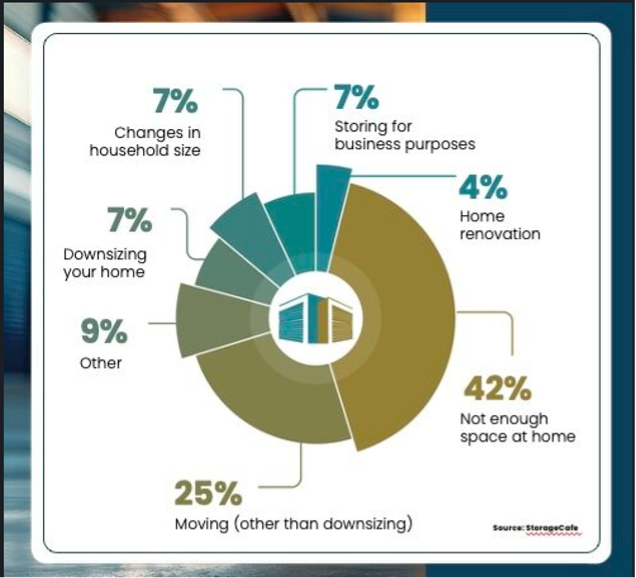
In good times and bad, self-storage facilities will always be in demand. When the economy is booming, household consumption increases and people have more items to store. During a downturn, people tend to downsize and move, using self-storage for their belongings. Businesses employ self-storage as a secure and economical replacement for office and warehousing space. A future-proof service, self-storage is reliably in demand.
Self-Storage Industry Snapshot
|
Annual industry revenue |
$44.33 billion |
|
Number of storage facilities |
52,301 facilities |
|
Total rentable storage space |
2.1 billion square feet |
|
Storage space per person |
6.32 square feet |
|
Percentage of households that rent a storage unit |
12.6% |
|
Average monthly cost for a |
$85.30 |
sparefoot.com; Yardi Matrix
Stable Market Drawing New Investors
Self-storage has had the highest total annual returns over 10-, 15-, 20- and 25-year averages in an analysis of several different property sectors, including residential, industrial, and office (National Association of Real Estate Investment Trusts). REITs, high net-worth individuals, family offices, and institutional investors including large private equity firms are investing in the self-storage market, fueling increased sales prices and acquisition activity.
Self-Storage Construction Spending
Self-Storage as a Low-Cost, High Performing Asset Class
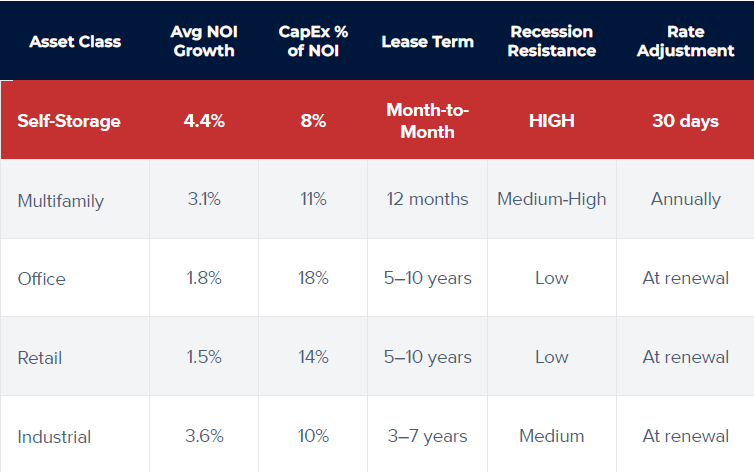
- Low operational costs related to personnel, maintenance/repair, capital expenditures, infrastructure, eviction expenses, utility costs.
- Strong NOI operating margins and low breakeven occupancy rates.
- Low turnover costs and easy management: show, rent, turnover, sweep and re-show.
- Fewer investors competing for opportunities than in other real estate asset classes.
- No rent regulation and month-to-month tenancies mean rental rates are immediately responsive to inflation and economic changes.
- Easy eviction/content auction.
- Low liability with no on-site tenants.
- Considerable opportunity for investment exists, with over 40% of owners being smaller operators.
- Scalable through expansion of an existing building or adding a new one, as development costs are much lower than for other asset classes.
Join Our Investor Network